

Advancing Circular Transformation
Winners of the Inaugural CTI Practice Mark Announced
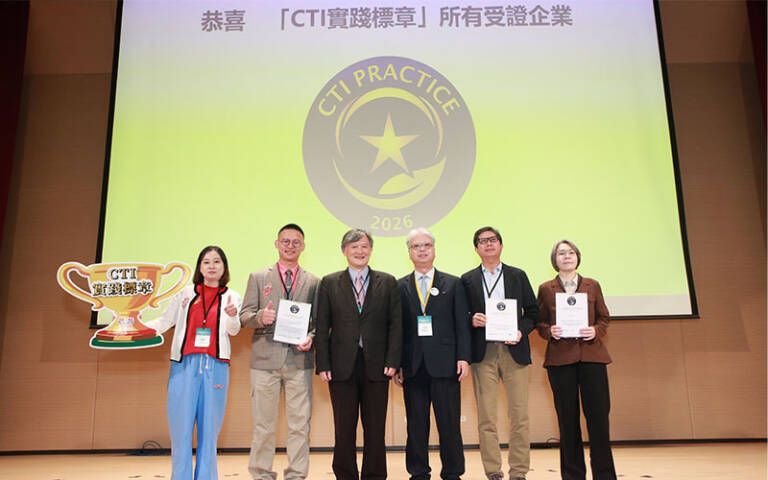
Photo: The inaugural winners of the CTI Practice Mark were announced on May 6. Mo Dong-li, Secretary-General of the organizer BCSD Taiwan, joined Lin Jun-xu, Director of the Chung-Hua Institution for Economic Research, for a group photo with representatives from the certified enterprises—DUO LI DUO FOODS CORPORATION, PC Recycle International, and Swancor Green Energy and Material.
The circular economy stands as one of the optimal solutions for sustainability, and a consistent, scientific measurement framework serves as the foundation for enterprises to assess their circular performance. In 2020, the WBCSD (World Business Council for Sustainable Development) initiated the long-term development of the "CTI" (Circular Transition Indicators) methodology and guidelines to drive the implementation of the circular economy. As a transparent and objective management tool, CTI assists enterprises across various industries, scales, value chain positions, and geographies in establishing reasonable baselines and targets. It also evaluates circular strategies through credible, quantitative metrics, serving as a vital basis for decision-making.
BCSD Taiwan began introducing the CTI methodology in 2022. To continuously assist Taiwanese enterprises in more actively applying CTI to enhance their circular economy initiatives, and in response to the establishment of the nation's "8+N Resource Circulation Alliance," the organization has successively released Traditional Chinese editions of industry guidelines for "Electronics," "Fashion and Textiles," and "Chemicals." The CTI industry guidelines delve into the critical challenges these three major industries may encounter when implementing CTI, proposing practical solutions while providing metric calculation frameworks and application examples from multiple corporations. It is an international management tool designed to help enterprises manage their progress in circular transformation. Furthermore, with the support of SinoPac Financial Holdings and Bank SinoPac, the council released "The GCP Framework and the Path of Circular Practice in Taiwan's Industry" last year. This publication presents the concrete actions and challenges faced by Taiwanese industries regarding circular transformation, offering a reference for enterprises to evaluate circular performance and adjust strategies, with the ultimate goal of accelerating the localized implementation of domestic industrial circular transformation.
To encourage enterprises to apply CTI for quantitative management, BCSD Taiwan collaborated with the Chung-Hua Institution for Economic Research to promote the "CTI Practice Mark" assessment mechanism, encouraging enterprises to apply. The evaluation committee for this cycle was composed of experts from Deloitte, KPMG, and PwC, who reviewed the applicant enterprises' "material circularity calculations" and "improvement action plans" through written documentation and presentations. The calculation process and results focused on whether the included data items and content met CTI calculation requirements. The improvement plans required the disclosure of concrete execution methods, potential challenges, and constraints, along with a quantitative assessment of expected benefits. Through the hands-on implementation of the CTI methodology, the initiative aims to establish practical capabilities within enterprises to measure and improve circular performance.
The inaugural CTI Practice Mark was awarded to the following three enterprises:
Swancor Green Energy and Material Co., Ltd.: The implementation focused on thermosetting resins, recycled carbon fibers, and recycled glass fibers with commercial potential. By using CTI calculations to identify circular bottlenecks, the company gave its improvement action plans a clearer sense of direction.
DUO LI DUO FOODS CORPORATION: The implementation focused on dried mango, bamboo salt, and milkfish. Although the food industry faces inherent challenges in increasing material circularity, the company actively proposed plans for packaging improvement, waste reuse, and energy management, demonstrating its ambition toward achieving full circularity.
PC Recycle International Co., Ltd.: Starting from a reverse logistics service model of laptop recycling and resale, the company demonstrated maturity in target setting and assessment boundary definition. It was able to identify areas of circularity loss through comprehensive material flow data, showcasing practical feasibility.
This certification indicates that the recipient enterprises have acquired the fundamental capability to apply the CTI methodology to calculate material circularity, from which they can discover potential hotspots for enhancing circularity and further develop their own optimal circular strategies. This year's mark is restricted to the scope of the applying company (excluding affiliates). Congratulations once again to the three enterprises mentioned above. Looking ahead, BCSD Taiwan will continue to advance circular transformation work, expecting more sustainability partners to jointly participate in the application, accumulate and demonstrate the strength of quantitative circular performance through credible indicators, and collectively make practical contributions to sustainable transformation.
News Source: bcsd Taiwan
https://bcsd.org.tw/special-promoted/special-info/20260507_circular_economy_cti_001/


