Home | News | 2026.05.06【Chung-Hua Institution for Economic Research】2026 International Sustainability Summit Commences: Winners of the Sixth Taiwan Circular Economy Awards Revealed
2026.05.06【Chung-Hua Institution for Economic Research】2026 International Sustainability Summit Commences: Winners of the Sixth Taiwan Circular Economy Awards Revealed
2026 International Sustainability Summit Commences: Winners of the Sixth Taiwan Circular Economy Awards Revealed
2026-05-06
Author: Chung-Hua Institution for Economic Research
The "2026 International Sustainability Summit" and the presentation of the sixth "Taiwan Circular Economy Awards" took place today, showcasing the latest practices of Taiwanese enterprises under nature-positive initiatives and circular transformation. This article focuses on how enterprises confront external environmental costs and supply chain carbon reduction pressures. As carbon emissions and resource risks begin to impact financial structures, the circular economy is becoming a new foundation for corporate competitiveness.
Hero Award Winners Shuang-lang Peng and Chun-chi Wu Deliver Sustainability Leadership: A Green Legend from Digital Transformation to Craft Inheritance
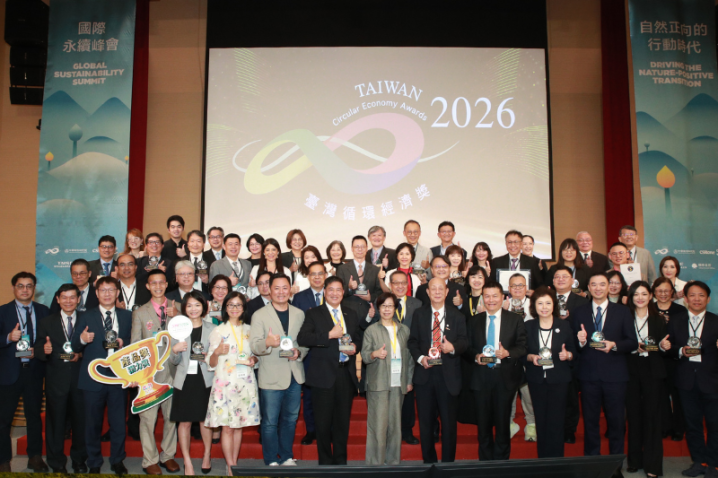
The awards ceremony for the "Sixth Taiwan Circular Economy Awards," organized by the Center for Green Economy of the Chung-Hua Institution for Economic Research, was grandly held today (6th) at the Center for Public and Business Administration Education of National Chengchi University. Collaborating with the CSRone Sustainability Think Tank, Cathay Financial Holding Co., Ltd., and the Taiwan Institute for Sustainable Energy, this year's grand event was themed "2026 International Sustainability Summit - The Action Era of Nature Positive." The venue gathered heavyweights and distinguished guests from industry, government, and academia to jointly witness the outstanding practices of 26 winning enterprises in balancing economic benefits with environmental sustainability.
Sustainability Giants: Defining the Heroic Spirit of the Circular Economy
The most high-profile highlight of this edition was undoubtedly the two "Hero Award" winners—Shuang-lang Peng, Chairman and Group CEO of AUO Corporation, and Chun-chi Wu, Founder and Chairman of Spring Pool Glass Industrial Co., Ltd. They have not only guided corporate transformations but have also driven transformations across entire industrial ecosystems with their personal visions.
Shuang-lang Peng: Reshaping Technology Resilience Through SmartManufacturing
Having been deeply involved in the information and communications technology industry for many years, Chairman Shuang-lang Peng firmly believes that "ESG is not a cost, but competitiveness." He led AUO Corporation to embed sustainability genes into its digital transformation, successfully creating Taiwan's first benchmark demonstration site for complete recycling of process water. To Chairman Peng, the circular economy is the ultimate manifestation of resource management; he has not only driven carbon reduction internally within the enterprise but has also mobilized tech supply chain partners for collective betterment in his capacity as the Chairman of the Taiwan Climate Alliance. His story is a model of a technology leader using data and intelligence to define a green future in a changing era.
Chun-chi Wu: Half a Century of Guarding the Land Through Glass Resource Circular Craftsmanship
Lauded as Taiwan's "most dedicated professional in glass recycling resources," Chairman Chun-chi Wu invested himself in the waste glass recycling and reuse business with unparalleled perseverance and foresight half a century ago, long before the circular economy became mainstream. Deeply believing that "there is no real garbage in the world, only resources placed in the wrong position," and relying on a high level of mastery over material characteristics alongside continuous technological research and development, he elevated crushed glass raw materials into "energy-saving glass" green building materials featuring fireproof, soundproof, and energy-saving functions, pushing Taiwan's glass recycling rate to the peak of second highest in the world. This original intention of guarding the land has endowed the traditional glass industry with an entirely new life vitality and environmental mission.
Gathering of Benchmarks: Sustainable Transformation From Large Enterprises to SMEs
Jun-xu Lin, Director of the Center for Green Economy at the Chung-Hua Institution for Economic Research, stated that as the global arena enters the action era of "Nature Positive," the circular economy is no longer merely a corporate environmental responsibility, but a core competitiveness for entering international supply chains and enhancing resilience. The winning enterprises of this edition demonstrated how to turn waste into resources, intellectualize manufacturing processes, and implement carbon inventories through digital management, establishing a grand paradigm for Taiwanese industries to align with international standards. For example, Hon Hai Precision Industry utilized AI to build a circular supply chain, winning the dual honors of the Enterprise Award "Exemplar of the Year" and the Sustainable Supply Chain Award "Outstanding Award"; Swancor Green Energy and Material won the SME Award "Exemplar of the Year" through breakthrough recycling technology for thermosetting materials, proving that the circular economy possesses robust commercialization potential.
To capture the quantitative information of enterprises, the awards ceremony simultaneously published the "Environmental External Cost Analysis Report." As global environmental regulations grow increasingly stringent, the invisible environmental costs generated by corporate operations (such as carbon emissions, water consumption, and waste) have become crucial risks affecting financial stability. Through auditing data from the sustainability reports of domestic listed and over-the-counter companies, it was discovered that if calculated using Taiwan's carbon fee of NT$300, the impact on net profits for high-carbon-emission industries (paper manufacturing, cement) reaches 70% to 100%; if calculated under the market price scenario of the European Union Emissions Trading System (EU ETS), the impact reaches as high as 800%, and 238 listed and over-the-counter companies generate environmental external costs exceeding NT$100 million. Furthermore, for industries such as financial insurance, digital cloud, machinery, and electronic components, their carbon emission pressures stem almost entirely from Scope 3 (upstream and downstream value chain emissions); taking the financial industry as an example, Scope 3 (mainly emissions from investment and financing) accounts for as high as 99.6%, indicating that an enterprise's own operational carbon emissions are merely the tip of the iceberg.
From Risk Warnings to a Dialogue Platform for Industry Consensus
The aforementioned data demonstrates the real challenges faced by Taiwanese industries in aligning with international standards. Therefore, in addition to commending enterprises, this year's grand event built a dialogue platform addressing future survival competitiveness, offering transformation references for enterprises facing environmental cost pressures, and establishing a transformation pathway within the global trend of the circular economy.
This website uses browser cookies to provide you with the best user experience. For details, please refer to this website's "Privacy Policy and Terms of Use".
If you choose to continue browsing this website or close this notice, it indicates that you agree to this website's terms of use and the use of cookies as specified in the terms. If you do not agree to the use of these cookies, please disable them according to the instructions in the privacy policy.